We are delighted to announce that Sketch for Survival, the international art initiative from conservation charity Explorers Against Extinction, will make its debut at Nature in Art this autumn. Now in its ninth year, this inspiring exhibition will be on display from 21 October – 16 November 2025, offering visitors a first chance to see the 2025 collection in full.
Every artwork in Sketch for Survival carries a message. Whether it portrays a threatened species, highlights an at-risk habitat, or reflects a wider conservation story, the art is designed to spark conversation and raise awareness about the urgent issues facing our natural world.
Since the initiative began, it has attracted artists from an incredible 119 different countries, united by a shared concern for wildlife and wild spaces. From thousands of entries received this year, just 100 artworks have been selected by our expert selection panel, chaired by renowned wildlife artist Gary Hodges. Each of these pieces has been donated by the artist, supporting both the campaign fund and the message behind it.
The exhibition at Nature in Art m arks the start of the Sketch for Survival 2025 tour. Following its debut here, the collection will move to the Oxo Tower Wharf in London, where the works will be available to view and bid for via online auction. The auction opens for browsing on 17 October and concludes at the close of the Oxo exhibition on 23 November.
Funds raised will support frontline conservation projects around the globe. In 2025, these range from protecting pangolins in Malawi, to safeguarding tigers in India, and conserving red pandas in Nepal.
We hope you will join us at Nature in Art to experience this powerful exhibition, which demonstrates how creativity and compassion can combine to make a tangible difference for the planet.
Sketching birds with Trevor Smith
Course Suitability: Suitable for all
Maximum Participants: 12
Course Description:
A one day workshop aimed at introducing and exploring the subject of sketching birds. Suitable for anyone with an urge to draw!
The day will include:
• A look at simple avian anatomy, focussing on the movement of the skeleton and feathers and their effects upon form and structure.
• Simple sketching techniques for capturing an image.
• A brief discussion on suitable materials for use in the field.
• A brief look at foreshortening effects.
• Adding colour to a sketch.
• Putting it all into practice using reference material.
Participants will need to provide the following materials:
1/ A good quality pad or book of cartridge paper, or loose sheets.
2/ A selection of B grade pencils, charcoal, or graphite drawing pencils.
3/ An eraser.
4/ A colour medium; for example: Watercolour, coloured pencils, pastels etc,
for applying colour to sketches if desired. (one medium is enough)
While colour can be applied onto cartridge paper with good results, watercolour, or pastel paper or board may be preferred by some participants.
NB – Reference material will be supplied on the day, but participants are advised to bring photographic reference of desired subjects, if the intention is to draw a particular species.
About the artist:
Trevor is a wildlife artist whose inspiration comes from British wildlife; working from life wherever possible.
Sketching in pencil and watercolour, his sketchbooks provide a unique connection to a living subject that is of great value to him; they provide a record of his encounters with wildlife and, acting as aide memoirs, allow recall of past events with clarity.
The immediacy of watercolour makes it his chosen medium with which to achieve this.
Trevor is self employed and has spent much of his career working in wildlife conservation.
‘Britain’s wildlife and wild places are under threat as never before. As wildlife artists we are better placed than many to witness this decline, but can also be influential in highlighting the loss of biodiversity by helping to shape opinion to reverse that loss’.
Trevor has taught fellow artists and novices alike to sketch birds, for many years now, specialising in passing on his experience of sketching from life, in the field.
To secure your place on this course a £25 non-refundable deposit is required.
All courses are £59 per day for members, and £75 for non-members
Painting still life with Lucy Burton
Course Suitability: Suitable for all
Maximum Participants: 12
Course Description:
In this workshop we are going to consider lots of compositional ideas and guidelines, arranging and lighting our fruit on a transparent plate with different coloured backgrounds. We will be looking to create interesting and unusual compositions, shadow shapes and colour relationships. We will then sketch out our composition on canvas, before applying the paint in a dynamic and interesting way: focusing on colour mixing, brushwork and how to paint shadows effectively.
What will be supplied:
A selection of fruits (or vegetables)
Coloured backgrounds
What to bring:
A canvas or board min A4, max A3, rectangular or square
A selection brushes eg. Rosemary Ivory Short Flats nos. 2,3,5, Ivory Filbert size 0
A selection of artist quality paints oils or acrylics eg. Daler Rowney starter set
A black sharpie and a ‘fine liner’ pen (or similar)
A spotlight or anglepoise desk lamp
Palette knife – eg. Winsor and Newton size 22
Paper Palette and a box to take your work home in
A phone or IPAD for taking photos
Oils only: A jar and some low odour thinners/ white spirit substitute for cleaning your brushes, some rags or plenty of tissues to wipe brushes clean.
Optional extra items
‘Liquin’ painting medium if working in oils
A ‘Stay-wet’ palette if working in acrylics
About the artist:
Lucy is an oil painter and teacher, living in Leamington Spa.
Whatever the subject matter, Lucy encourages students to apply the paint in a dynamic and interesting way: focusing on colour mixing, brushwork and composition.
She paints commissions, sells her work and exhibits locally with ‘Leamington Studio Artists’…and has also:
• Worked as the ‘Artist in Residence’ at ‘The Artroom’ Gallery in Leamington,
• Painted live at ‘Blenheim Palace Flower Show’
• Been a wildcard artist on ‘Landscape Artist of the Year’
• Exhibited with ‘Warwickshire Open Studios’
Places are on a first come first basis.
To secure your place on this course a £25 non-refundable deposit is required.
All courses are £59 per day for members, and £75 for non-members
Book here – £118 / £150, £25 deposit required to book
Course Suitability: Absolute beginners, Beginners, Improvers
Maximum Participants: 12
Course Description:
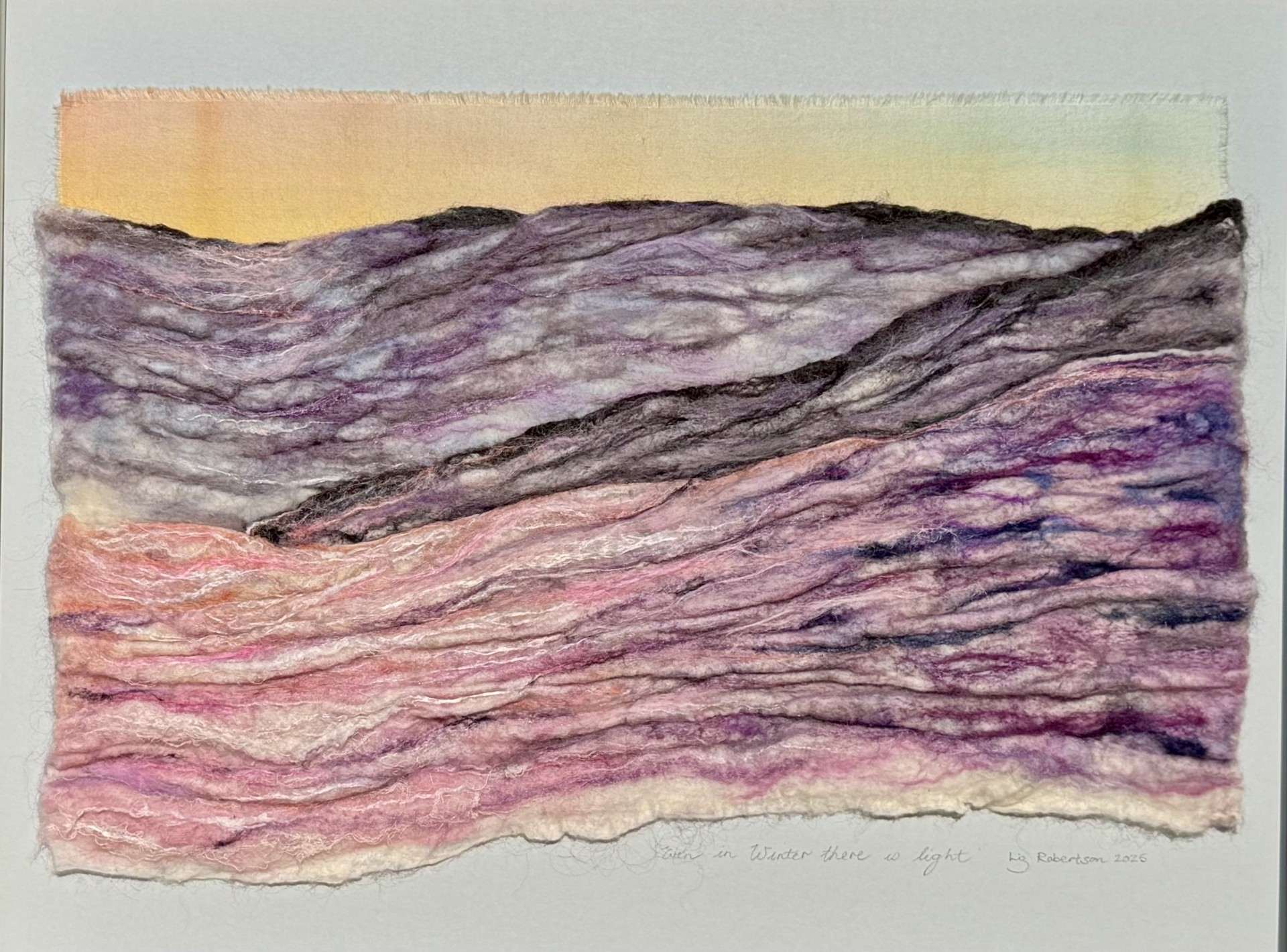
Everyone has their favourite season. Winter is often overlooked because of the harshness of winter weather at times and shorter daylight hours. However, Liz wants you to look at Winter through a different lens: softer colours and light; deeper, dramatic contrasts; extraordinary views ‘through’ a wooded landscape; the ‘other-worldly’ quality of snow and its effect on a landscape.
Liz always aims to provide a really accessible course for all levels of textile art experience. She will teach you several textile techniques which feature in her own textile artwork, including; fabric painting, wet felt making, needle felting, applique of considered materials, stitch and collagraph printing. You will use a selection of these techniques (or all!) to create a Winter landscape of your choice.
Please bring along any photos, sketches, dried or fresh plants that you would like to use as inspiration. Additional materials will also be available.
Materials Required:
Please bring a variety of Winter landscape photos to inspire the artwork you’ll produce during the course.
You may wish to bring an apron and gloves as we will be using paint.
Liz will provide the required art materials for course participants. The cost per person will be £5.00 which will be paid to Liz by the participants.
About the artist:
Liz is a textile artist and teacher. Her textile artwork is exhibited in galleries, community settings, including Gloucester Cathedral, and featured in a national publication. She has 40 years experience of teaching in all types of educational settings. She delivers art workshops in her studio and further afield, including at national events. Liz is delighted to have been Artist in Residence at Nature in Art, including in September this year. She has also lead large textile art projects, for a regional arts festival, arranging and featuring in UK-wide exhibitions. Liz’s passion for natural landscape is expressed in her colourful and textural textile artwork.
This selling exhibition of contemporary crafts draws inspiration from the urgent themes of the UN’s International Year of Glaciers’ Preservation. The works celebrate the beauty of glaciers, polar regions, ice, snow, and water; life-giving and fragile. Exhibits range from ceramics, wood, glass, jewellery, enamels, prints and more.
 .
. 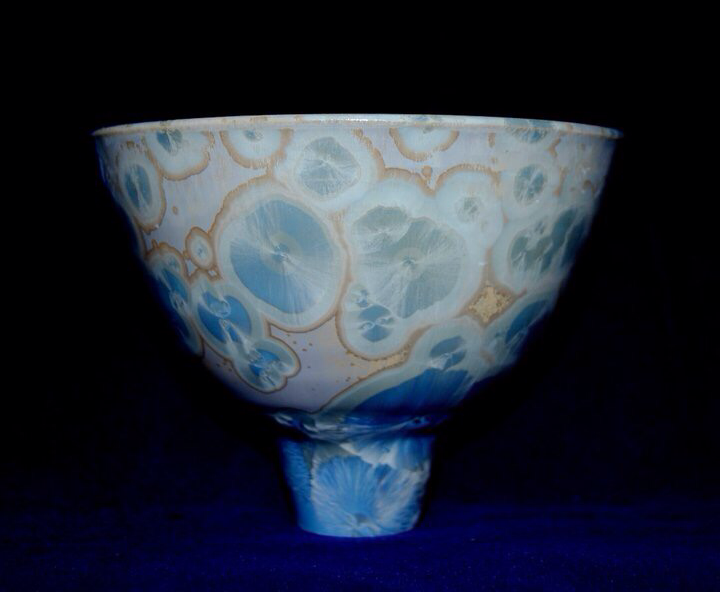
Amongst the makers represented are Colin See-Paynton (wood engravings), Amanda Lawrence (glass left above), Carole Bury (mixed media), Robert Cox (wood), Nigel Calvert (glass), Avril Farley (ceramics, right above), Grahame Tucker (wood), Siddy Langley (glass), Ben Venuto (printmaking), Linda Heaton-Harris (ceramic sculpture), Paul Hannaby (wood), Sarah Kinnersley (jewellery), and Grant Sonnex (Furniture and ceramics) .
As has been the case in past years, the majority of the exhibits in this exhibition will be for sale.
The Seasons in Landscape Painting
An illustrated talk by Martin Bowden
Following a thirty-five year career as Head of Economics and Art History at Dean Close School, Martin is now a talented painter whose work is inspired by the likes of
JMW Turner, Edward Seago, Aubrey Phillips and John Palmer. This talk will take us on a journey exploring a wide variety of artistic styles encompassing the work of, for
example, the Limbourg Brothers, Pieter Breughel, Jean Francois Millet among others. Often there is personification of the seasons so spring is a time of rebirth, summer
a time of heat and ripeness, autumn a time of harvest and winter a time for snow and the hearth. An inspiring talk for all.
Doors open 7pm to view galleries. Finger buffet at 7.30pm followed by talk.
Papercutting with Sarais Crawshaw
Course Suitability: Suitable for beginners and improvers
Maximum Participants: 12
Course Description:
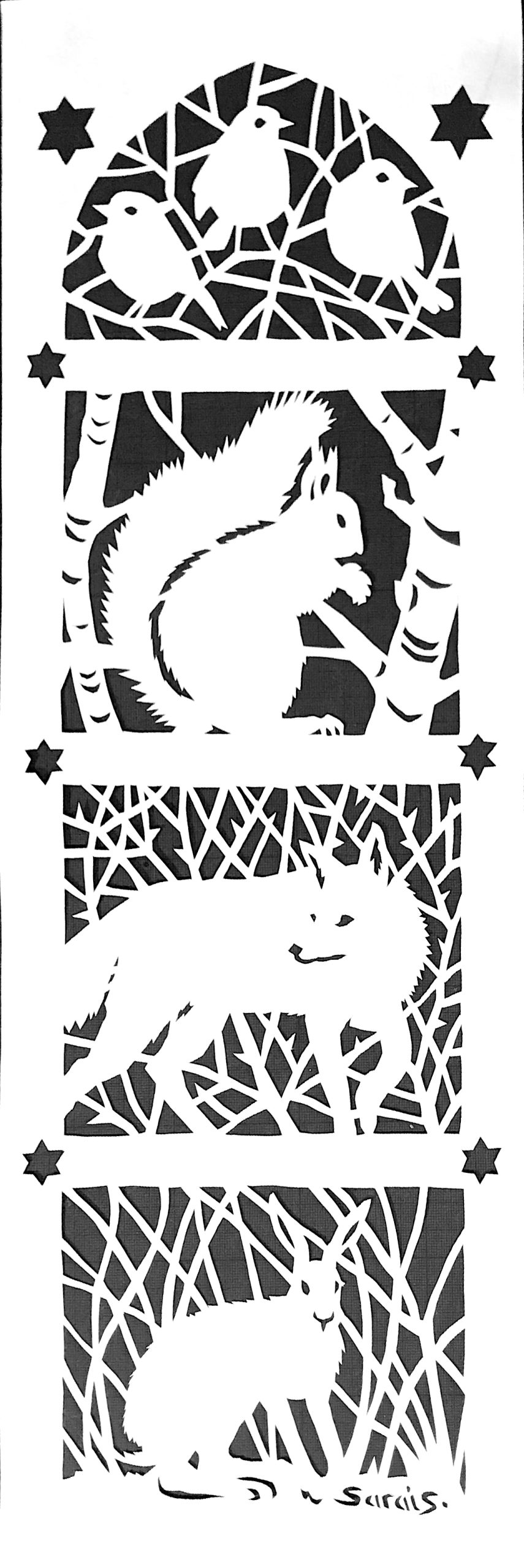
Learn about the origins of papercutting and its spread worldwide. Look at how to simplify images in positive and negative space, and make networks of joins to hold a papercut together. Experiment with different tools and types of cuts, folders and tears to create different effects and to use contract or colours to enhance the images. Create a one or two-layer papercut picture.
What to bring:
A materials list will be supplied, alternatively students can order from the artist.
About the artist:
I have always been curious about the natural world and my work reflects this fascination with wildlife and wild places. Since 2000, I have been developing my own ideas in papercut, alongside my other artwork in acrylic paint and pastel. I try to capture the behaviour and character of animals, and to picture them in their wild habitats. I am President of the Wildlife Art Society International.
Places are on a first come first basis.
To secure your place on this course a £25 non-refundable deposit is required.
£59 per day for members, £75 for non-members
Christmas celebration with mulled wine and festive snacks
With the Ukranian Choir ‘Kozachky’
The Ukrainian vocal ensemble ‘Kozachky’ was created in October 2022 from a group of women who were forced to leave their homes and relocate to Bristol because of the war. The group hails from different parts of Ukraine: Kyiv, Odesa, Lviv, Melitopol, Kharkiv, Zhytomyr, Vinnytsia. Come and hear some wonderful Ukranian songs being sung from the heart with some more familiar songs performed too. Do come and support these singers!
Doors open 7pm to view galleries. Finger buffet at 7.30pm followed by concert.
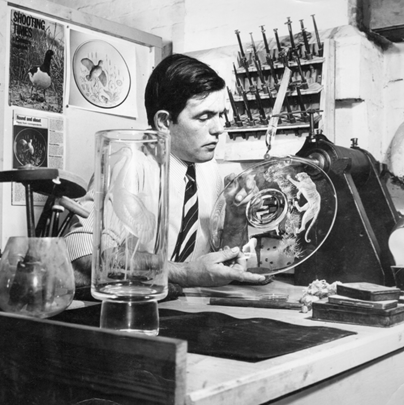

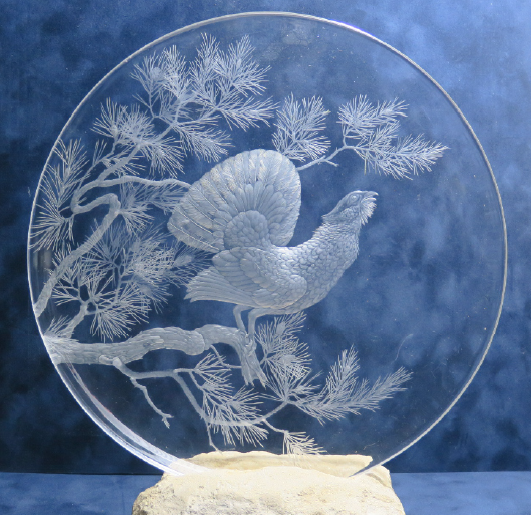
We were very sad to have had to report early last year, the passing of the renowned glass engraver and long-time trustee of Nature in Art, Michael Fairbairn (1935 – 2024). He had been a wonderful encourager of Nature in Art and has left a remarkable legacy of engraved glass in public and private hands. To honour Michael’s contribution to Nature in Art and to give people the opportunity to re-aquaint themselves with his remarkable work, this is a unique selection of his engraved glass, mostly borrowed from private collections, many never previously displayed in public.
At the age of 13 Michael won a scholarship to attend the Stourbridge Secondary School of Art. He wasn’t keen, but his parents insisted he took up the opportunity. Fortunately for Michael, he was encouraged by his tutor George Webb who one day gave him a lead crystal tumbler to engrave and a picture of a roe deer. He gave him hints and tips on how to control the wheel and how much abrasive to use. So began a remarkable career.
Michael excelled at the college and went on to gain a National Diploma in Design which led to a three year scholarship at The Royal Collegeof Art which he completed after his National service.Michael graduated in 1961 with a Silver medal for work of special distinction in glass engraving and was immediately commissioned to make a piece to fit into the crook belonging to Rev. Bardsley, Bishop of Coventry.
Following a short spell in industry Michael moved into secondary education teaching engineering drawing at Cirencester Comprehensive. But, in 1968, he was given the opportunity to take up the tenancy of a farm, which he later purchased and farmed for decades. He kept up this passion for engraving whilst running a farm and the commissions he would get helped run the business.
Michael was one of the founding members of the Guild of Glass Engravers and was a life member of Gloucestershire Guild of Craftsmen. His experience and training enabled him to accomplish many engraving styles but his speciality was wildlife themes and settings. Such was his enthusiasm for this subject that in the 1970’s he undertook the daunting task of producing a series of engraved items of threatened and endangered species. Over 50 species were each depicted on three separate items – 150 pieces that took over 4 years to complete. Part of the proceeds were given to World Wildlife Fund.
Throughout his long career, the majority of his output was commissioned including many from royalty and government.
His detailed, painstaking approach and mastery of the technique is refreshingly set apart from the modern mania for computer-aided design and mass-produced work and stands out as a testament to the enduring significance of meticulous craft-based skill. Visitors to this show will be encouraged to look at the glass, all the while remembering that it has been engraved, not by moving the tool over the glass, but by moving the glass over the tool, sometimes engraving on both sides of the glass.
We sincerely thank all the collectors who have loaned work for this display.
Fresh from its launch at the Natural History Museum, London, see the 100 winning and commended images from the very latest competition. Selected from over 60,000 entries from 113 countries this is an awe-inspiring show. Get a glimpse of the show here.
Bringing the family? Download the NHM’s printable activity trail here!

