We are delighted to announce that Sketch for Survival, the international art initiative from conservation charity Explorers Against Extinction, will make its debut at Nature in Art this autumn. Now in its ninth year, this inspiring exhibition will be on display from 21 October – 16 November 2025, offering visitors a first chance to see the 2025 collection in full.
Every artwork in Sketch for Survival carries a message. Whether it portrays a threatened species, highlights an at-risk habitat, or reflects a wider conservation story, the art is designed to spark conversation and raise awareness about the urgent issues facing our natural world.
Since the initiative began, it has attracted artists from an incredible 119 different countries, united by a shared concern for wildlife and wild spaces. From thousands of entries received this year, just 100 artworks have been selected by our expert selection panel, chaired by renowned wildlife artist Gary Hodges. Each of these pieces has been donated by the artist, supporting both the campaign fund and the message behind it.
The exhibition at Nature in Art m arks the start of the Sketch for Survival 2025 tour. Following its debut here, the collection will move to the Oxo Tower Wharf in London, where the works will be available to view and bid for via online auction. The auction opens for browsing on 17 October and concludes at the close of the Oxo exhibition on 23 November.
Funds raised will support frontline conservation projects around the globe. In 2025, these range from protecting pangolins in Malawi, to safeguarding tigers in India, and conserving red pandas in Nepal.
We hope you will join us at Nature in Art to experience this powerful exhibition, which demonstrates how creativity and compassion can combine to make a tangible difference for the planet.
This selling exhibition of contemporary crafts draws inspiration from the urgent themes of the UN’s International Year of Glaciers’ Preservation. The works celebrate the beauty of glaciers, polar regions, ice, snow, and water; life-giving and fragile. Exhibits range from ceramics, wood, glass, jewellery, enamels, prints and more.
 .
. 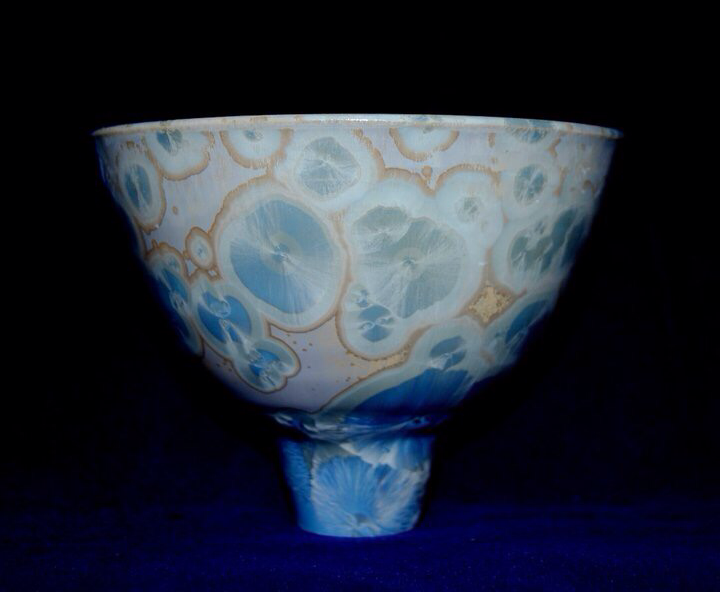
Amongst the makers represented are Colin See-Paynton (wood engravings), Amanda Lawrence (glass left above), Carole Bury (mixed media), Robert Cox (wood), Nigel Calvert (glass), Avril Farley (ceramics, right above), Grahame Tucker (wood), Siddy Langley (glass), Ben Venuto (printmaking), Linda Heaton-Harris (ceramic sculpture), Paul Hannaby (wood), Sarah Kinnersley (jewellery), and Grant Sonnex (Furniture and ceramics) .
As has been the case in past years, the majority of the exhibits in this exhibition will be for sale.
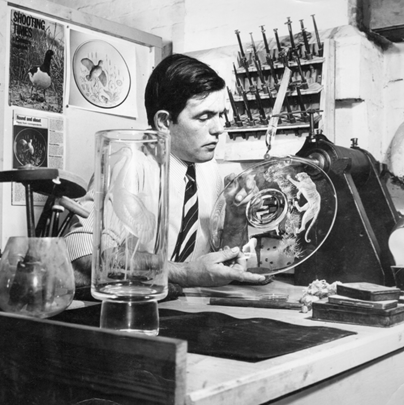

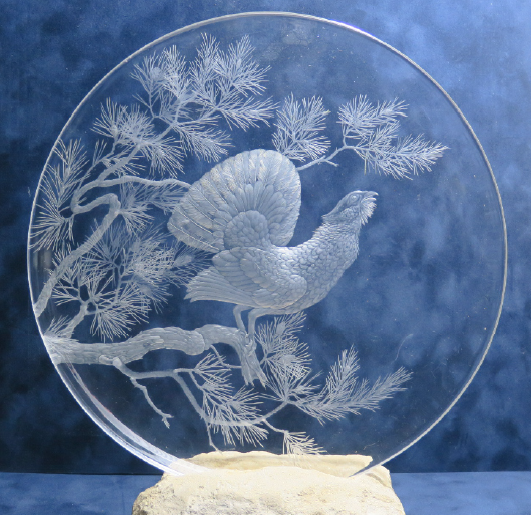
We were very sad to have had to report early last year, the passing of the renowned glass engraver and long-time trustee of Nature in Art, Michael Fairbairn (1935 – 2024). He had been a wonderful encourager of Nature in Art and has left a remarkable legacy of engraved glass in public and private hands. To honour Michael’s contribution to Nature in Art and to give people the opportunity to re-aquaint themselves with his remarkable work, this is a unique selection of his engraved glass, mostly borrowed from private collections, many never previously displayed in public.
At the age of 13 Michael won a scholarship to attend the Stourbridge Secondary School of Art. He wasn’t keen, but his parents insisted he took up the opportunity. Fortunately for Michael, he was encouraged by his tutor George Webb who one day gave him a lead crystal tumbler to engrave and a picture of a roe deer. He gave him hints and tips on how to control the wheel and how much abrasive to use. So began a remarkable career.
Michael excelled at the college and went on to gain a National Diploma in Design which led to a three year scholarship at The Royal Collegeof Art which he completed after his National service.Michael graduated in 1961 with a Silver medal for work of special distinction in glass engraving and was immediately commissioned to make a piece to fit into the crook belonging to Rev. Bardsley, Bishop of Coventry.
Following a short spell in industry Michael moved into secondary education teaching engineering drawing at Cirencester Comprehensive. But, in 1968, he was given the opportunity to take up the tenancy of a farm, which he later purchased and farmed for decades. He kept up this passion for engraving whilst running a farm and the commissions he would get helped run the business.
Michael was one of the founding members of the Guild of Glass Engravers and was a life member of Gloucestershire Guild of Craftsmen. His experience and training enabled him to accomplish many engraving styles but his speciality was wildlife themes and settings. Such was his enthusiasm for this subject that in the 1970’s he undertook the daunting task of producing a series of engraved items of threatened and endangered species. Over 50 species were each depicted on three separate items – 150 pieces that took over 4 years to complete. Part of the proceeds were given to World Wildlife Fund.
Throughout his long career, the majority of his output was commissioned including many from royalty and government.
His detailed, painstaking approach and mastery of the technique is refreshingly set apart from the modern mania for computer-aided design and mass-produced work and stands out as a testament to the enduring significance of meticulous craft-based skill. Visitors to this show will be encouraged to look at the glass, all the while remembering that it has been engraved, not by moving the tool over the glass, but by moving the glass over the tool, sometimes engraving on both sides of the glass.
We sincerely thank all the collectors who have loaned work for this display.
Fresh from its launch at the Natural History Museum, London, see the 100 winning and commended images from the very latest competition. Selected from over 60,000 entries from 113 countries this is an awe-inspiring show. Get a glimpse of the show here.
Bringing the family? Download the NHM’s printable activity trail here!


Young Artists Exhibition
Join us as we celebrate the young artists of Gloucestershire, in their interpretations of Our Great Outdoors: Art Inspired by the Natural World’.
Free to enter, in the Education Centre

Valerie Dugan
GSBI Annual Exhibition
Founded in 1993, the Gloucestershire Society for Botanical Illustration (GSBI) grew out of botanical art classes held in Cheltenham and Stroud with Michael Hickey, botanist, writer and illustrator for The Cambridge University Press.
For many years the GSBI has held its annual show at Nature in Art. As usual, exhibits this year are varied in style and mediums. All members, whether new or experienced, are exhibiting up to three pieces of their work.
Originals, prints and cards are for sale and visitors are encouraged to vote for a ‘People’s Favourite’.
A number of the Society’s more experienced members have won The Royal Horticultural Society’s Gold, Silver Gilt and Silver Medals or have gained distinctions with the Society of Botanical Artists.
Free to enter, in the Education Centre


This is the first time that we have shown a collection of work drawn and painted with raw earth and rock pigments prepared and transformed into paint and inks by the artist.
They are the latest pictures by Fiona McIntyre, whose work has been deeply influenced by living in Scotland, Scandinavia and Spain. She is a founding member of the Arborealists art movement and an elected associate member of the Royal Society of Painter-printmakers (ARE) and an RE councillor.
Recent years have been a revelation for Fiona who has changed her way of working, largely through research and experimentation. So, before committing ideas to paper or canvas Fiona says, ‘I now make my own paints from mineral pigments, some of which I forage, and I gather plants to make natural inks. Having largely rejected synthetically made media, my eyes have been opened to the extraordinary beauty and resonance of nature’s bounty when transformed into media for the artist’.
The project Sacred Earth: Water, Tree, Stone has been a labour of love. The wild landscapes of Iceland, Scotland and Galicia are the inspiration for this exhibition. These locations continue to need protection from glacial melting and erosion, so this exhibition has three themes running through it, based on basic building blocks of life – water (Iceland), tree (Scotland) and stone (Galicia).
She says ‘I spent time walking sketching and drawing in all of these wild locations, witnessing glaciers, pine forests and petroglyphs. These places were at times difficult to get to and weather was unpredictable. However, this is what inspires me to feel alive and excited. I hope that the experiences of being immersed like this in rain, snow, winds and sunshine will be transmitted to the viewers of my art’.
As well as paintings and drawings, visitors will be able to learn about natural pigments and the process of making paints. Fiona says ‘Mineral pigments have a translucent quality, as if capturing the light and memory of the landscapes from which they were sourced’.
The exhibition coincides with the launch evening (April 18th) of a new book of the same name with contributions from Christiana Payne, Professor Emerita of History of Art at Oxford Brookes University and Nicola Moorby, Curator of Historic British Art, 1790 – 1850 at Tate Britain. Copies will be available in Nature in Art’s shop.
See also: Natural Materials Into Paints & Inks with Fiona McIntyre on May 2nd-3rd

Mother of Pearl Butterfly by Phillip Grieve (south Africa. b.1922)
Animal A-Z
Biodiversity is the variety of life on Earth, in all its forms, from genes and bacteria to entire ecosystems such as forests or coral reefs. Biodiversity forms the web of life that we depend on for so many things, including food, water, medicine, a stable climate and economic growth.
Over half of global GDP is dependent on nature. More than 1 billion people rely on forests for their livelihoods. And land and the ocean absorb more than half of all carbon emissions.
But nature is in crisis. Up to one million species are threatened with extinction, many within decades. Irreplaceable ecosystems like parts of the Amazon rainforest are turning from carbon sinks into carbon sources due to deforestation. And 85 per cent of wetlands, such as salt marshes and mangrove swamps which absorb large amounts of carbon, have disappeared.
The main driver of biodiversity loss remains humans’ use of land – primarily for food production. Human activity has already altered over 70 per cent of all ice-free land. When land is converted for agriculture, some animal and plant species may lose their habitat and face extinction. But climate change is playing an increasingly important role in the decline of biodiversity too. It has altered marine, terrestrial, and freshwater ecosystems around the world and has caused the loss of local species, increased diseases, and driven mass mortality of plants and animals, resulting in the first climate-driven extinctions.
climate-driven extinctions.
In response to this, the UN Environment programme has many initiatives, including the Kunming-Montreal Global Biodiversity Framework (GBF), adopted by 196 parties at COP15 in December 2022 under the UN Convention on Biological Diversity. It is a landmark plan to halt and reverse biodiversity loss by 2030 and achieve ‘living in harmony with nature’ by 2050. It includes 4 goals and 23 targets, such as protecting 30% of land/seas by 2030 and mobilizing billions of dollars annually for nature. The framework was unexpectedly encompassing, and provides hopes for building a new relationship between people, the economy and nature.
Just before the framework was agreed in 2022, the WWF Living Planet Report was released. It estimated a 69 percent average decline in wildlife populations since 1970. A frightening statistic.
So, this display has brought together a special selection of works for each year of the 21st century highlighting 26 animals, one for each letter of the alphabet. Together, they remind us of the diversity and wonder of nature and encourage us to not only celebrate the skill of the artist, but be reminded again, through their work, of the fragility of much of nature in the world today.
Rather than place the diverse exhibits together in one room, the 26 items, both 2D and 3D, will be scattered throughout the museum, to be searched out on an ‘art safari’. Younger visitors can follow a trail to help them discover the exhibits.

CRUCIFIXION
BE STILL | BE QUIET
“The greatest thing a human soul ever does in this world is to see something, and tell what it saw in a plain way. Hundreds of people can talk for one who can think, but thousands can think for one who can see. To see clearly is poetry, prophecy and religion, all in one.” John Ruskin
In seeing Darrell Warner interprets and creates natural history paintings in watercolour that may be uncomfortable at first. That is of course the intention, to arrest the viewer into a reality that they may not care to think about. And there’s the rub. In doing so, Warner eludes to a life lost yet his paintings, predominantly of our own indigenous birds are testimony to those birds’ souls continuing to sing, even in death.
At the beginning of the covid pandemic when our world was last at rest it seems, Warner would come across deceased everyday common or garden birds struck by a passing vehicle. Being Spring of 2020 and the likelihood that those unfortunate birds would be in or entering breeding season weighed heavily on the painters mind, so much so that he was unable to cast them aside, instead seeking to record their deaths in watercolour. And so begun an odyssey to record those lost souls that entered his orbit via friends and family, be it from the humble Blackbird to the elusive Water Rail.
What became apparent is how many deaths are caused by or related to human actions or environments, from vehicle to conservatory window strikes. Considering the small community in which he lives, Warner began to wonder of the overall number of avian life lost on a daily basis across both county and country. That thought became the catalyst to this exhibition. The call to raise awareness of the loss through these paintings. It is apparent that our natural world is under very serious threat from both increased green belt development and a general apathy towards what nature is and does. Small incidental deaths don’t factor into this equation but certainly add to nature’s fine balance. As we enter further into the 21st century one can only hope that Warner’s observations and recordings of these beautiful creatures remind us of what is at stake and what were once very common could become rather rare. A crucifying thought. Darrell Warner is an Internationally acclaimed artist & illustrator known predominantly for his work on large Hollywood Blockbusters. Yet his personal work has also gained international recognition whilst being a quiet testament to his true skill as a draughtsman and artist, seeking to ask questions of how we look and relate to both art and nature.
Meet Darrell amongst the exhibits all day Saturday May 23rd
Join us for an illustrated evening talk by Darrell on Saturday June 12th.


Lesley Connolly and Lucy D’Auvergne
Wildlife Art Society International Annual Show
One of a series focusing on our desire to highlight and encourage active creative groups celebrating the natural world.
Over 300 works in a huge variety of media celebrating artistic endeavour and the diversity of nature. Artists at work every day.