This is a unique selection of work assembled exclusively for this display – a celebration of the whale. It includes a few familiar exhibits and artists already represented in Nature in Art’s collection, shown in the company of pieces not previously seen at Nature in Art. In addition, we have developed some supporting activities, a talk, videos and the creation of a participatory artwork, all generously assisted by a grant from The Art Fund as part of The HERDS project.
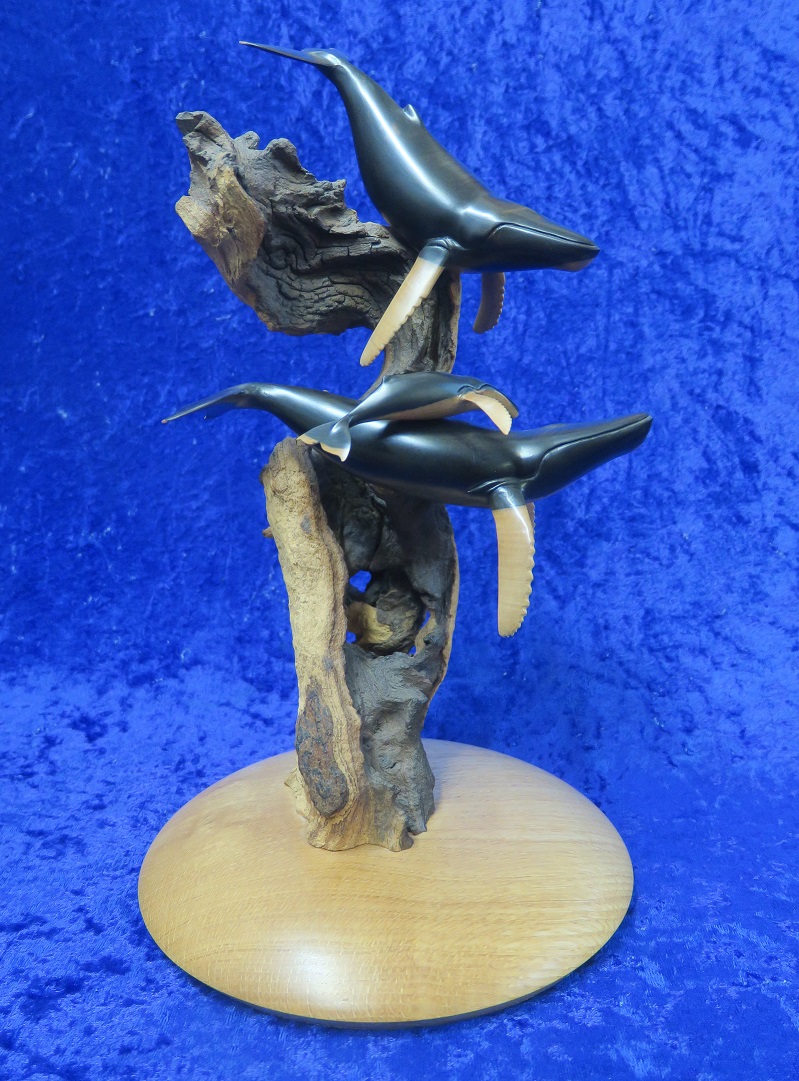
As well as drawing our attention to the whale species, their beauty and how they can point us to hopeful messages, the exhibition will encourage visitors to think about some of the pressing threats on the marine environment and climate change which cannot be ignored. The exhibition includes both 2D and 3D works, including this bronze sculpture of a humpback whale by Nick Bibby.
Two of the artists, whose work is focused on the marine environment and are exhibiting at Nature in Art for the first time, are Tom Ashworth and Olivier Leger.
Tom is renowned for his depictions of whales. As people arrive at Nature in Art and look right into one of the downstairs galleries they will see his 3.2m wide work made of 6 separate painted panels depicting the head of a sperm whale and a squid.
Tom says of this piece ‘A phone call on the morning of 3rd March 2011 sent me scampering to the coast near to where I live at Pegwell Bay to find a large male sperm whale had beached itself. To see a cetacean out of its element leaves you feeling sadness for its demise while, at the same time, experiencing awe at being in the presence of something totally alien. This work is the fourth actual–size whale painting that I have attempted and is the largest that isn’t a site specific mural. It is based on the Pegwell stranding and inspired in no small part by Philip Hoare’s book ‘Leviathan’.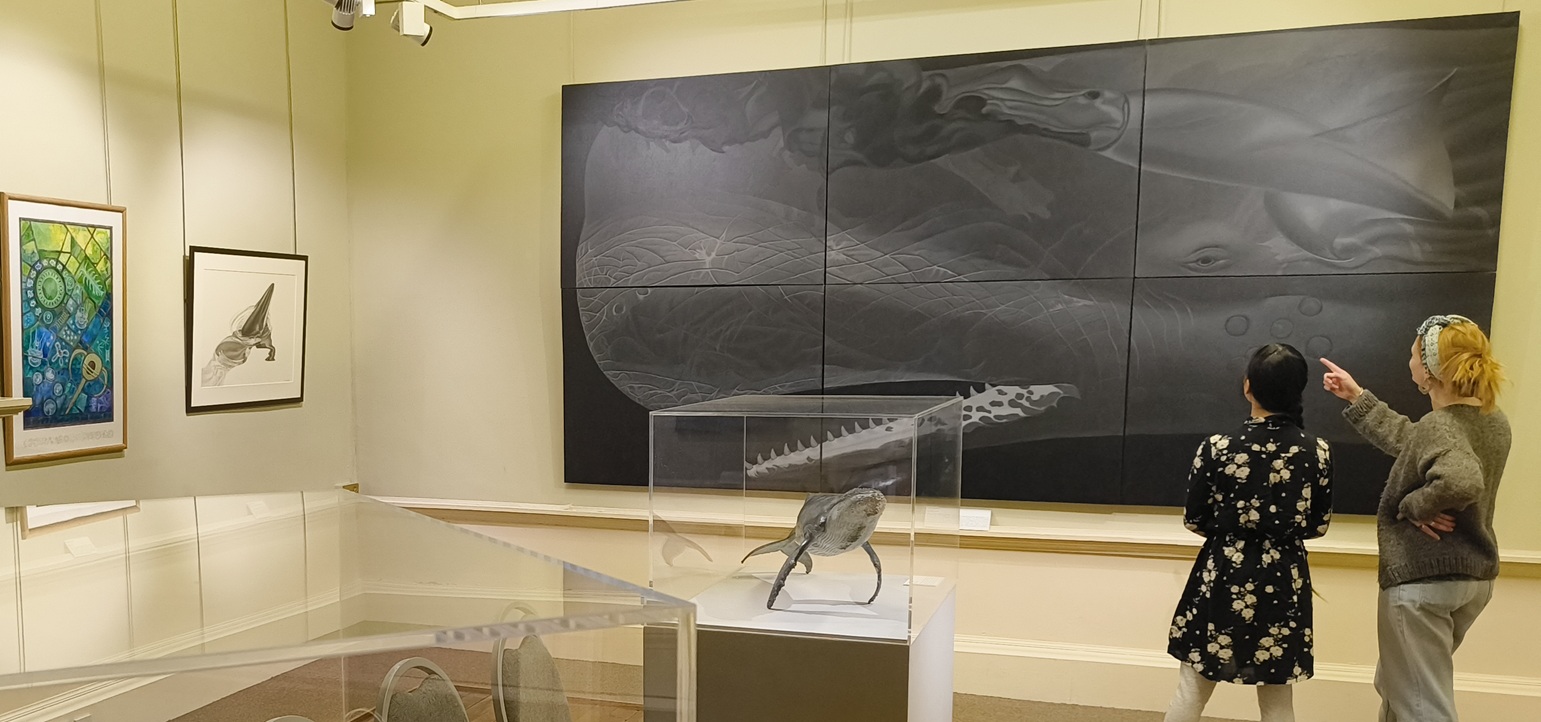
Accompanying this major piece will be a number of Tom’s smaller works depicting a variety of different whale species. Tom is passionate about whales and has a lifelong interest in cetaceans. He uses whale imagery to explore ideas about conservation, their adaptations to an environment alien to us and how we have related to them throughout our history and culture. His intention is to produce work which lives in the space between fine art and illustration, using acrylic paint or pencil.
Looking left when they arrive, visitors will see in the other gallery Olivier Leger’s 2.2 m wide ink work. Called ‘Whaley McWhaleface’, it took 6 months to create. Olivier told us about how it was created …. ‘To help tackle the scale and complexity, I made a small plan of the composition and sketched the outline onto my drawing board …. then the ideas and details evolved as I worked my way inch-by-inch across the drawing, worked with fine-tipped pen (0.03mm) and ink.
Unlike my previous drawings on paper, this piece is created on a gessoed (a hard primer) board. Whereas paper is unforgiving, this surface allowed me to smudge, sand, scratch, and render in new ways. I broke some rules and I loved it!
A mother humpback whale with her calf embark on a remarkable migration. As you look closer, a thousand tiny details reveal themselves; the ocean animals making their home in the coral reefs that have established on her colossal body. ‘Whaley McWhaleface’ provides sanctuary for the ocean life inhabiting the thriving ecosystems and vibrant habitats she carries, kept safe from humanity’s impact on the sea.
The world’s humpbacks are making a comeback. Their recovery gives hope that our oceans can be restored. ‘Whaley McWhaleface’ is a symbol of that hope. Within her sphere, ocean life thrives; turtles congregate around flourishing coral gardens, a squadron of manta rays hitch a ride on the current and hammerhead sharks school in the shallows.’
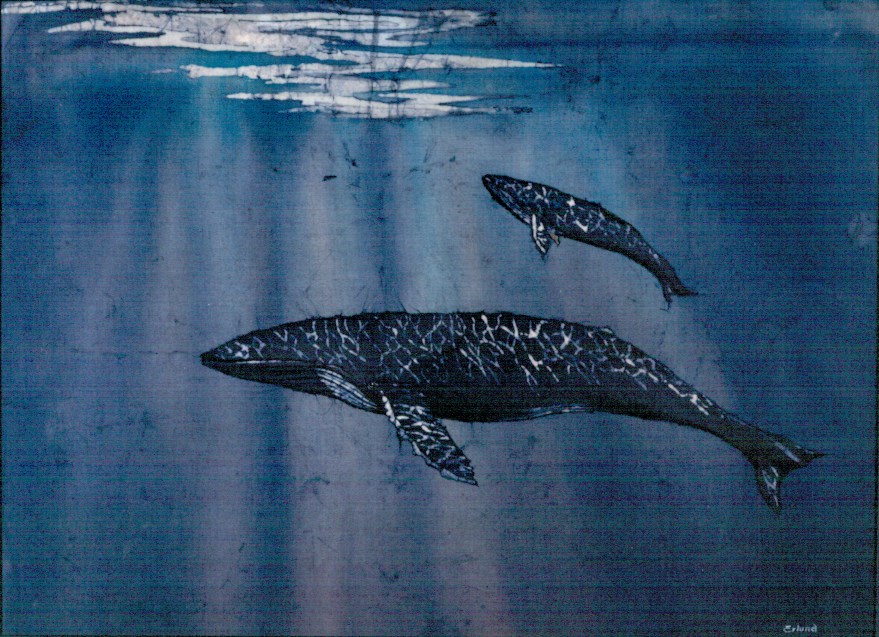
Other artists represented in the show include Sir Peter Scott, Darren Rees, Dafila Scott, Martin Hayward-Harris, Nick Bibby, Bruce Pearson, Shelley Perkins, Derek George, Tanya Russell, Beth Erland and others. Many of these works have personal stories behind them. For example, in 1983 Peter Scott spoke at the Whales Alive Conference in the USA. He described a whale- watching excursion he experienced as ‘mind blowing’. He committed his memory to canvas, and the resulting painting is included in this exhibition (left). The animal shown, that breached at least 8 times, once within fifty yards of his boat, was a well-known female humpback who researchers had named ‘Pegasus’ (the name of the painting). Also, one of Darren Rees’s exhibits was worked on while he was artist in residence at Nature in Art; Shelly Perkins’s resulted fr om her residency with Scott Polar Research in the Antarctic, and Martin Hayward Harris’s sculpture was a maquette for the life-size blue whale at the Natural History Museum in London, that he was involved in making.
Sir Peter was a passionate campaigner for whales and some of his profound words regarding whales will be included in the exhibition. He would want people not only to enjoy the artwork included, but to engage with some of the conservation issues that the artwork highlights.
As part of the exhibition there will be an installation, made by younger visitors in preceding weeks, reflecting on human impact on whales and the marine environment, plus videos to increase our knowledge, including with Elsie Knight, aged 12, interviewing marine researchers.
To complement the exhibition, Chris Butler-Stroud of Whale and Dolphin Conservation will be giving an illustrated talk, ‘People of the Sea’, on July 10th. More details here.
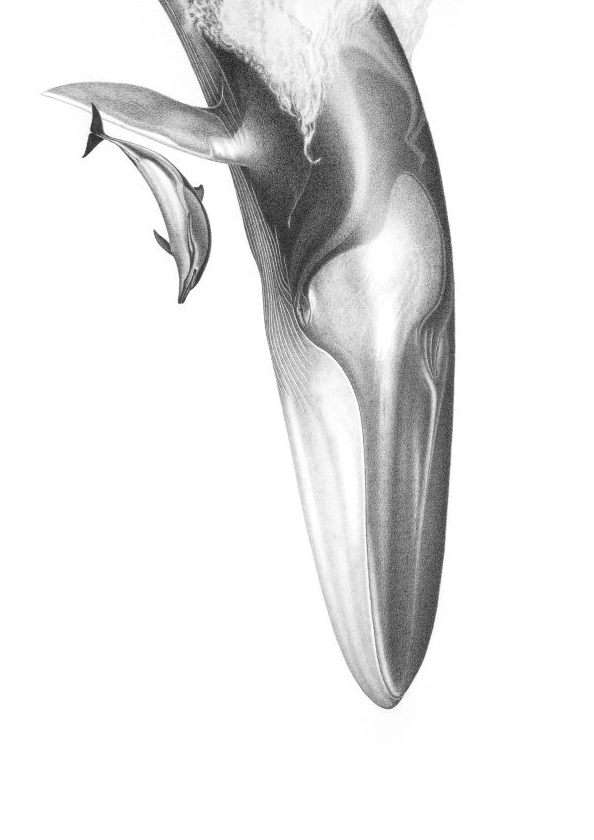
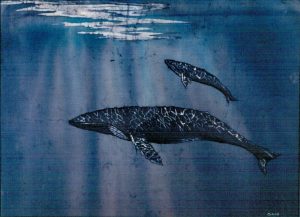
Image: Left: Fin whale and dolphin by Tom Ashworth Below: ‘Take a Breath’ Humpback whales (Batik) by Beth Erlund (USA), and Humpback whale (bronze) by Nick Bibby