NOW EXTENDED TO 23rd July (was 16th)

A unique selection of work by the popular UK cartoonist, Norman Thelwell.
This year marks the 100th anniversary of the birth of one of Britain’s most popular cartoonists to have worked in Britain since the Second World War, Norman Thelwell (1923 – 2004). Although best known for his images of girls and their fat ponies, his work is far more wide ranging than many realise. The countryside and environment were particular passions that informed his work. His cartoons were a powerful way for him to comment on issues of the day.
‘Wrestling with a Pencil’ was the title of Thelwell’s autobiography (1984), and in it he says ‘Although my object as a cartoonist was mainly to earn my living by amusing readers, it was also quite possible to express my own feelings on subjects, situations and events about which I felt strongly. Politics I have always found very boring and there was no way in which I could have become a political cartoonist. My interest lies in the minutiae of the human dilemma, the day to day problems of life and the way we are all swept along by events or developments which we feel helpless to influence. I seem to have touched at one time or another on almost every subject under the sun from combine harvesters to computers, rockets to ramblers, paraffin to pigs. But the predominant thread which has always run through my work is my love of and fascination with the countryside: the flesh and bones of these islands.’
This exhibition will include a broad selection from a remarkable body of work produced over a lifetime. The selection was made with the assistance of Thelwell’s artist son, David, who will be artist in residence at Nature in Art in June, and Thelwell’s daughter, Penny.
In 1952, Thelwell penned his first cartoon for the satirical British magazine Punch, renowned internationally for its wit, irreverence, and for publishing the world’s best comic writers and poets. This led to a relationship that lasted for 25 years and over 1,500 cartoons, including 60 front covers. Some original Punch cartoons will be included in this exhibition.

Thelwell published his first pony cartoon in 1953, and quite by accident, his name became synonymous with images of little girls and fat hairy ponies. The ‘Thelwell pony’ quickly became the most-often referenced source of horse humour the world over, and today, as we prepare to celebrate the centennial of the artist’s life, his caricatures remain as popular as ever. Thelwell’s 34 books have sold over 2 million copies in the United Kingdom alone, and his cartoons are found on a diverse array of merchandise. Interestingly, when we need it most, his book ‘The Effluent Society’, which commented on environmental issues, was republished this March. (This, and some other merchandise will be available in the shop.)
Lent by the family archive, this display, although including a few of his renowned horse and pony pictures, also embraces serious paintings completed purely for pleasure, and drawn and painted cartoons with relevance to nature, the countryside and environment, plus early works from his army days in India and before. Together they reveal not just Thelwell’s skill as an artist, but also his mastery of sharp social comment and his awareness of then current and future threats. He used satire to convey serious messages about the need to preserve the natural world; many of which still have poignancy today.
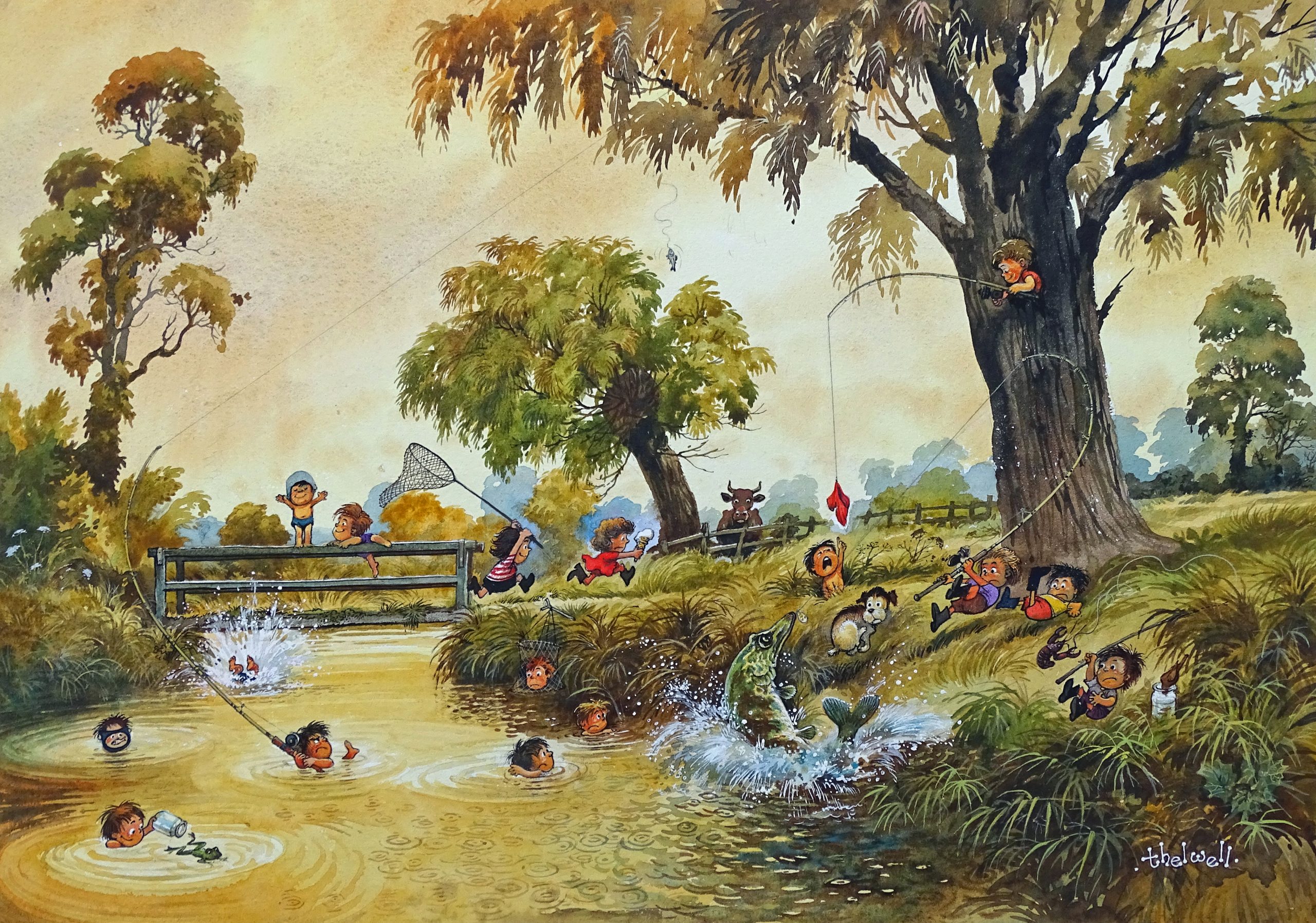
Many of his 34 books centre upon country life and country pursuits, and their light-hearted images are founded upon a thorough knowledge of their topics. (He was a keen angler, for example.) Although progress has been made in some areas of conservation and the tackling of environmental challenges, it is likely that Thelwell would be disappointed that many of his cajoling drawings are as relevant today as the day he put pencil to paper. Things have not changed as much as he would have liked.
For the last quarter of a century of his life Thelwell lived in the Test Valley at Timsbury, gradually restoring a farm house and landscaping the grounds which gave rise to his first factual book, ‘A Plank Bridge by a Pool’, which detailed the first two lakes he dug there. A third lake was later featured on the BBC TV. Written much earlier, but published three years later, ‘A Millstone Round My Neck’ described his experiences in re-building a Cornish water mill that was sold before the book was published. He always loved old buildings, and in his autobiography, ‘Wrestling with a Pencil’ he wrote about his joy of old cottages.
